There’s a time in almost every industry when an impactful shift upends what doing business looks like.
Farming has always been the backbone of society, but for many young people today, the idea of becoming a farmer feels out of reach. Land is expensive, climate conditions are unpredictable and the upfront costs of equipment and infrastructure can be overwhelming. That’s where automated container farms come in, offering a new pathway for the next generation of farmers to thrive.
Unlike traditional models, container farms don’t require hundreds of acres or decades of experience passed down from family. They’re compact, climate-controlled and highly efficient. Most importantly, they harness automation and technology, which makes them a natural fit for younger generations who grew up with smartphones, data analytics and digital tools at their fingertips. With sensors that monitor and control environmental conditions, automated watering and nutrient delivery systems, and detailed dashboards that track results, farming suddenly becomes less about guesswork and more about innovation.
This shift doesn’t just make agriculture more approachable, it makes it exciting. Young people who might never have considered farming can now view it as a career rooted in technology, sustainability and entrepreneurship. Container farms offer consistent, year-round production regardless of outside weather conditions, which speaks directly to a generation deeply concerned about climate change and food security. The controlled environment also uses a fraction of the water and land required by traditional farming, aligning with values of environmental stewardship that many young people hold close.
At the same time, container farms double as living classrooms. Schools, universities and community organizations are already using them to teach students about biology, engineering, natural resources, coding and even business management. Hands-on experience with these systems not only connects learners to where food comes from, but also equips them with skills they can carry into careers in ag-tech, sustainability or entrepreneurship. It’s a form of education that blends science with purpose, and it leaves a lasting impression.
Perhaps most empowering of all is the way container farms connect young people to their communities. These systems allow farmers to grow fresh food locally, reduce reliance on long supply chains and provide nutritious produce to underserved areas. Many young entrepreneurs are finding purpose in this mission, using container farms to build small businesses that serve both their neighborhoods and the environment. By removing many of the traditional barriers to farming, container farms open the door to opportunity and impact.
At its core, this movement is about redefining what it means to be a farmer. Agriculture is no longer confined to wide-open fields and unpredictable harvests. With the rise of automated container farms, farming has become a forward-thinking, tech-enabled career choice that blends innovation with sustainability. For the next generation, it’s not just about growing food—it’s about shaping the future of our food systems in a way that is accessible, resilient, and deeply meaningful.
Seismic shifts in how we operate as a society are happening all around us, and some days, it seems like it’s all happening at once. The food industry is no stranger to change, and it’s constantly having to acclimate to a variety of external factors that are forcing this change.
In a world facing mounting environmental, social and economic pressures, the way people grow food is undergoing a radical transformation. No longer confined to traditional outdoor fields in rural settings, food production is now taking root in cities, repurposed buildings and even shipping containers. From climate change to shifting consumer preferences, multiple interconnected factors are reshaping how and where people cultivate crops, and the ripple effects are touching everything from supply chains to dinner plates. Let’s take 5 minutes to explore the primary forces driving these shifts and how they’re shaping the future of food production.
Climate Change and Unpredictable Weather
Perhaps the most significant factor reshaping food production is shifting climates. As global temperatures rise, traditional agricultural zones are experiencing unpredictable weather patterns, more frequent droughts, floods and rampant wildfires. Crops that once thrived in certain regions are now at risk, leading to decreased yields and food insecurity.
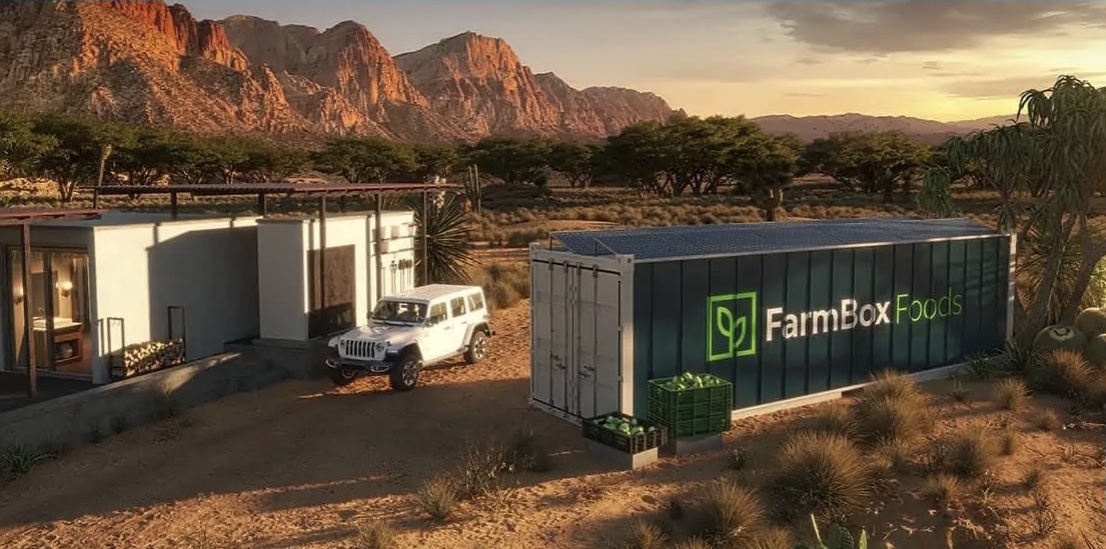
A rendering of a FarmBox Foods container farm in an arid region.
In some areas, once-reliable growing seasons are moving or shortening. Farmers are being forced to either adapt their methods — using drought-resistant seeds, rotating crops, or investing in irrigation — or abandon fields altogether. This instability is prompting innovators to explore controlled-environment agriculture, which includes hydroponics, aeroponics and aquaponics systems in greenhouses and vertical farms.
Indoor farming methods allow growers to remove weather variability from the equation, offering a stable, year-round growing environment. As weather extremes continue to escalate, climate-resilient farming will only grow in importance.
Urbanization and Land Scarcity
With over half of the world’s population now living in urban areas—and that percentage expected to climb, the availability of arable land near cities is shrinking. Urban sprawl devours farmland, forcing food to travel further to reach consumers. The longer the distance, the greater the transportation costs and the larger the carbon footprint.
To combat this, urban agriculture is emerging as a viable solution. Rooftop gardens, community farms and repurposed buildings are being transformed into micro-farms that feed local populations. Innovations such as modular container farms, which are portable and space-efficient, are enabling hyperlocal food production, even in areas with little or no traditional farmland.
The benefits of growing food close to where it will be consumed include reduced transportation costs, fresher produce and increased food security in densely populated areas. This localized approach is essential for making food systems more sustainable and resilient.
Technological Advancements in Agriculture
Technology is rapidly changing every aspect of farming. Precision agriculture, powered by sensors, artificial intelligence and satellite imagery, allows for more efficient use of water, fertilizers and pesticides. These tools help maximize yields while minimizing environmental impacts.
But the innovation doesn’t stop at the field. In indoor environments, growers are leveraging automation, climate controls and data analytics to maintain optimal growing conditions for each crop. LED lighting systems can be tuned to the specific wavelengths that stimulate plant growth (full-spectrum, anyone?), while real-time monitoring ensures that nutrients and water are delivered with pinpoint accuracy. This is a cornerstone of FarmBox Foods’ approach. Targeted and timely dosing, watering and lighting.
With the rise of “smart farms,” technology is making it easier to grow food in places that were once considered inhospitable. Whether it’s a basement in Brooklyn or a desert outpost, technology is unlocking new possibilities in agriculture.
Evolving Consumer Expectations
Today’s consumers are more educated and environmentally conscious than ever. They want to know where their food comes from, how it was grown, and what its impact is on the planet. Many are prioritizing local, organic, and sustainably grown options, even if it means paying a premium. This consumer shift is influencing how food is grown. Transparency, traceability and low environmental impact are becoming selling points. Supermarkets, restaurants and wholesalers are responding by sourcing more produce from local or eco-friendly farms, and in some cases, creating partnerships with indoor farming operations.
The “farm-to-fork” movement is no longer a fringe trend — it’s becoming an expectation. As people demand fresher, cleaner and more ethically produced food, growers are changing their practices to align with these values.
Global Supply Chain Disruptions
The COVID-19 pandemic, followed by geopolitical tensions and logistical bottlenecks, revealed just how fragile global food supply chains can be. Delays, labor shortages and inflation caused widespread disruption, highlighting the dangers of relying too heavily on international suppliers for essential goods like food.
As a result, many communities and governments are investing in decentralized food systems. Localized production provides a buffer against global instability and reduces the risks associated with long-distance transportation. In this context, indoor and urban farming offer an appealing solution, not just for sustainability, but for strategic resilience.
Building regional supply chains allows for greater control, adaptability, and community engagement. It also helps stimulate local economies by creating jobs in agricultural technology (softened shortened to ‘agtech’), operations and logistics.
Water Scarcity and Resource Efficiency
Water is one of agriculture’s most critical and overused resources. Traditional farming consumes roughly 70 percent of the world’s freshwater supply, and in many regions, aquifers are being depleted faster than they can recharge. With water becoming increasingly scarce, especially in drought-prone areas, growers must rethink how they use this precious resource.
Soilless systems like hydroponics and aeroponics can reduce water usage by up to 90 percent compared to conventional methods. These systems recycle water within closed loops, dramatically lowering waste. As water stress intensifies, efficient farming methods will become indispensable for maintaining food production.
Resource-efficient agriculture also reduces the need for fertilizers and pesticides, which helps protect nearby waterways from runoff and pollution. This makes modern farming not just more productive, but more environmentally responsible.
Policy and Investment Trends
Governments, investors and institutions are recognizing the urgency of agricultural innovation. From grants for indoor farming startups to tax incentives for sustainable practices, public policy is beginning to reflect the need for resilient, future-proof food systems.
At the same time, venture capital and impact investors are pouring funds into agtech, alternative proteins, and regenerative agriculture. This influx of capital is accelerating the development and deployment of scalable farming solutions that can meet growing global demand.
Policies that support urban agriculture, reduce barriers to entry and promote food justice are also helping expand access to healthy food in underserved communities. These developments underscore the growing recognition that food security is inseparable from environmental stewardship and social equity.
The Future of Food is Flexible
As climate challenges intensify, populations grow and urban centers expand, how and where we grow food must evolve. What’s emerging is a more decentralized, diversified and tech-driven food system that emphasizes sustainability, efficiency and local resilience.
Multiple forces, such as climate, consumer demand, economics, technology and policy, are converging to redefine agriculture for the 21st century. While the traditional farm is far from obsolete, it’s now part of a much broader landscape that includes vertical farms, container farms, rooftop greenhouses and other creative solutions that haven’t even been invented yet.
Ultimately, the future of food will depend not on any single approach, but on a mosaic of practices adapted to local needs, conditions and cultures. By embracing innovation while honoring the principles of stewardship and equity, we can create a food system that nourishes both people and the planet.