
Josh Mahurin’s journey to Beats Per Minute Farms in Leavenworth, Kansas, didn’t begin with the controlled hum of LED lights or the steady rhythm of hydroponic pumps. It started decades earlier, in the backyard gardens of his childhood. 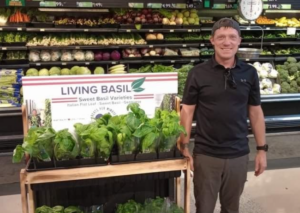
His parents were prolific growers, and the family’s property was a patchwork of food production: long rows of beans and cucumbers, towering corn, sprawling patches of okra and asparagus, strawberries creeping along the edges, fruit trees laden with apples, pecans and walnuts. They even kept roughly a thousand rabbits, a responsibility that taught Josh early on what it meant to care for living things.
“I was always the kid who liked to do that kind of thing,” he recalled.
When other students were gravitating toward more traditional electives, Josh enrolled in every plant-related class his high school offered: greenhouse management, botany, landscaping. His parents had gone so far as to build a greenhouse into the side of their home, where starter plants like tomatoes were nurtured each spring before finding their place in the soil. Their yard was a tangle of green, and nearly everyone around him grew something. It was a lifestyle, a rhythm, a constant.
But after high school, life quickly changed course. It was 2002, less than a year after the terrorist attacks of September 11. Many of his peers headed toward the Marines or the National Guard. Josh chose the path less traveled: the United States Coast Guard.
“No one was doing it,” he said.
For the next 12 years he served aboard ships, becoming both a mechanic and a law enforcement officer. He was certified on a dozen different engines, excelled as a machinery technician and eventually reached the rank of MK2, a role that required a wide breadth of technical skill.
As he approached his 11-year mark, a question began to unsettle him: Where would he be at 38 if he stayed until retirement? Would that second transition be even harder? Ultimately, he decided to leave at 30, a decision grounded in both practicality and the sense that he was ready to build something new. For several years he’s worked in hardwood flooring with a highly skilled team led by the director of the national wood-flooring association. Craftsmanship came naturally to him, but something was missing.
The turning point arrived when he met Mike and Karen through a veteran program. Mike, a paraplegic, and Karen had a large, empty shop space and a desire to build something meaningful. They were exploring agricultural opportunities suitable for their physical needs and long-term goals. Josh saw possibility where others might’ve seen limitation.
Their research led them first to Freight Farms and then, through a farming convention at Kubota, to FarmBox Foods. The latter opened the door to a new form of agriculture: controlled-environment basil production on a commercial scale. What began as experimentation with multiple basil varieties soon evolved into a precise and highly optimized operation.
Italian large-leaf basil was initially in high demand, but they learned quickly that grocery retailers didn’t just care about flavor, they cared about shelf life. Despite the flavor profile and customer requests, Italian large-leaf basil simply didn’t hold up in cold storage. Genovese basil, however, was a different story. Not only did it last significantly longer, but its performance in the controlled environment was exceptional. Leaves the size of a hand appeared by the second trim. By the time the plants hit their fourth internode, they were producing giant, deeply aromatic foliage.
Inside the container, productivity rose sharply.
“We were pulling about 160 pounds of straight leaves per month,” Josh noted.
The process was efficient and consistent. He preferred trimming the bottom leaves, while Justin, his crew member, handled upper sections. Their customers received neatly cut stems, typically about three-quarters of the main stem removed and packaged for freshness. Even with this output, demand often exceeded what they could produce.
Basil wasn’t their only crop. Rosemary germinated reliably, and thyme grew prolifically. They even brought in an external consultant to help refine their methods, but much of the troubleshooting and upgrading fell naturally to Josh because of his background. Technical challenges excited him.
“These farms attract nerds,” he laughed.
Working with Mike and Karen added another layer of purpose to the job. He speaks with particular admiration for Karen, who despite her disability works harder than most fully able-bodied people he’s ever met.
“She doesn’t stop,” he said. “Every day there’s something new she impresses me with.”
She made sure tubes were clean, systems were maintained, and despite the physical demands of farming, she showcased relentless drive. 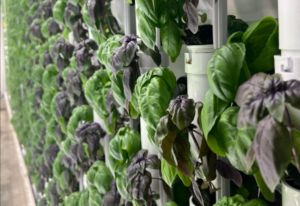
For Josh, container farming held unexpected therapeutic value.
“It’s simple in a good way,” he said.
After years in the military, and later in trades where constant motion and alertness were the standard, the farm provided a calm, focused workspace. Operating the system, which involves checking parameters, matching functionality to expected outputs and assessing plant health, fit neatly with the procedural rhythm of his Coast Guard experience. AgroTek’s controls were similar enough to PLC systems he’d used in the service that the transition felt natural.
He believes this industry holds unique promise for veterans. In the military, staying still is rare, and office jobs often feel stifling to those used to physical, task-oriented work. Container farming delivers the best of both worlds: meaningful hands-on responsibility without overwhelming complexity.
“It takes your mind off things,” he said.
There’s satisfaction in seeing plants respond to the environment you manage, how their stomata develop, how CO2 exchange works, how the ambient conditions shape their growth. He monitors everything: leaf burn, water on the floor, lighting, irrigation. The farm becomes a living system governed by both science and intuition.
At Beats Per Minute Farms, Josh serves as co-owner, crew leader and operations manager. He’s been there since the beginning, shaping the operation from an empty building into a highly efficient controlled-environment farm. His role blends his backgrounds in gardening, mechanical systems, problem-solving, technical precision and mentorship. Most of all, it connects him to something that feels both grounding and purposeful.
“I just enjoy working with plants,” he said. “And knowing everything is functioning properly.”
That quiet sense of order, of living things thriving under his care, ties him back to where his story started: a family garden, a greenhouse built into the side of a house, the smell of tomato starters in the spring. In a way, he never really left. Only the setting changed. The mission didn’t.